Many students ask, “Can I prepare for Banking, SSC, OSSC, OSSSC and Railway examinations together?”
The answer is Yes—provided you prepare intelligently.
Most competitive examinations share a large portion of their syllabus. With proper planning, you can prepare for multiple exams without multiplying your workload.
Here’s how.
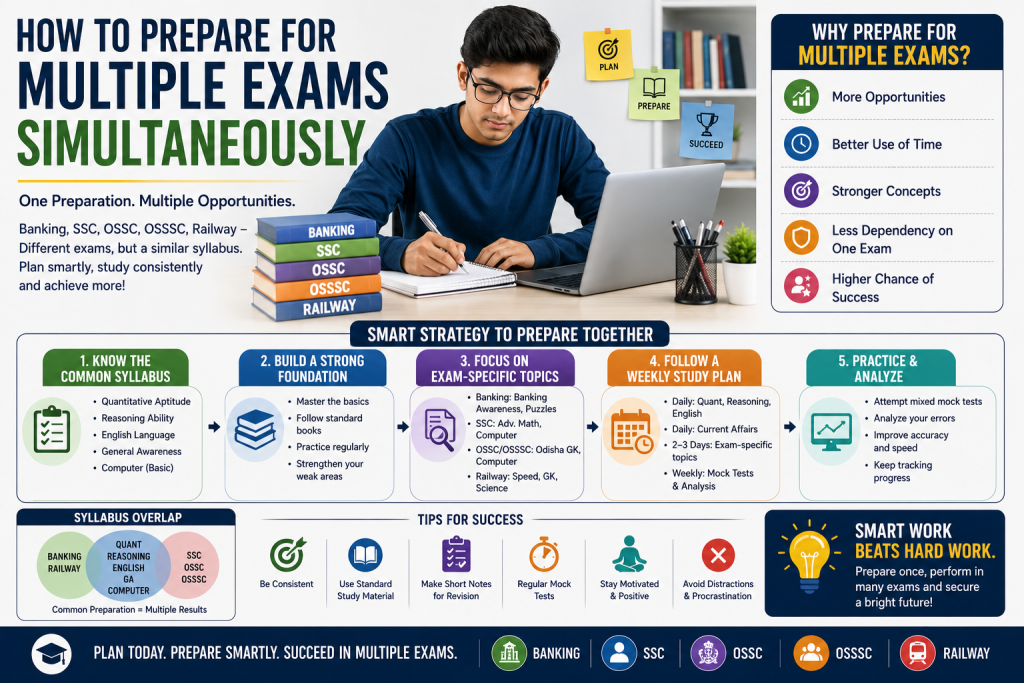
1. Understand the Common Syllabus
The biggest mistake students make is treating every examination as completely different.
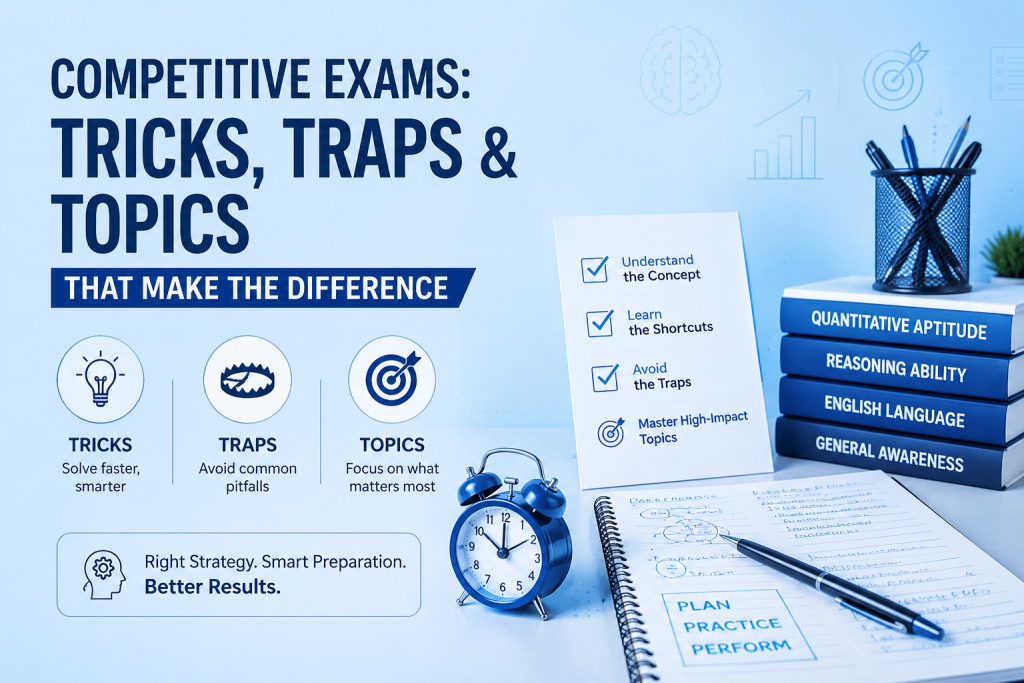
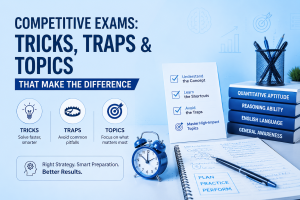
In reality, most exams include common subjects such as:
- Quantitative Aptitude
- Reasoning Ability
- English Language
- General Awareness
- Computer Awareness (in many exams)
Mastering these subjects builds a strong foundation for several examinations at once.
2. Build a Common Foundation First
Instead of preparing exam-wise, prepare subject-wise.
For example:
- Complete Arithmetic before moving to advanced topics.
- Build Reasoning concepts before attempting difficult puzzles.
- Strengthen English grammar and vocabulary.
- Develop a daily habit of reading Current Affairs.
Once the foundation is strong, adapting to different exams becomes much easier.
3. Know the Exam-Specific Topics
After covering the common syllabus, focus on the unique requirements of each examination.
Examples include:
| Examination | Additional Focus |
| Banking | Banking Awareness, Speed, Puzzle Solving |
| SSC | Advanced Mathematics, Computer Knowledge |
| OSSC | Odisha General Knowledge, Computer |
| OSSSC | Odisha GK, Basic Computer, Simpler Aptitude |
| Railway | Speed, General Science, Current Affairs |
This approach saves time and avoids unnecessary duplication.
4. Maintain One Study Schedule
Avoid making separate timetables for each examination.
A better weekly plan is:
- Quantitative Aptitude – Daily
- Reasoning Ability – Daily
- English – Daily
- General Awareness – Daily (30–45 minutes)
- Exam-specific topics – 1–2 sessions each week
- Mock Test & Analysis – Every week
One structured schedule is easier to follow consistently.
5. Practise with Mixed Mock Tests
Do not limit yourself to only one exam pattern.
Practise:
- Banking mocks
- SSC-level questions
- OSSC and OSSSC papers
- Railway previous year papers
This improves adaptability and prepares you for different question styles.
6. Focus on Accuracy Before Speed
Many students try to solve questions quickly from the beginning.
Instead:
- Learn the concept.
- Practise correctly.
- Build accuracy.
- Increase speed gradually.
Speed naturally improves with consistent practice.
7. Track Your Progress
Every week, review your preparation.
Ask yourself:
- Which subjects improved?
- Which topics remain weak?
- How did you perform in mock tests?
- What should you revise next week?
Small improvements every week lead to significant progress over time.
Advantages of Preparing for Multiple Exams
✓ More career opportunities
✓ Better utilisation of study time
✓ Reduced dependence on a single notification
✓ Stronger conceptual understanding
✓ Continuous motivation throughout the year
Preparing for multiple exams increases your chances of success without requiring separate preparation for each one.
Common Mistakes to Avoid
Avoid these common errors:
- Studying only after notifications are released.
- Ignoring common subjects.
- Switching books every week.
- Attempting too many resources.
- Skipping mock tests and revision.
Consistency is more important than studying long hours.
Final Thoughts
Preparing for multiple competitive examinations is not about studying more—it is about studying smarter.
A strong common foundation, regular practice, weekly mock tests and focused preparation for exam-specific topics can help you perform well in Banking, SSC, OSSC, OSSSC and Railway examinations together.
The right strategy allows one preparation to open the door to many career opportunities.
Prepare Once, Compete Everywhere with Amrit Academy
At Amrit Academy, our integrated coaching model is designed around the common syllabus of Banking, SSC, OSSC, OSSSC and Railway examinations. Students build a strong foundation first and then receive focused guidance for exam-specific topics, regular mock tests and performance analysis—making one preparation useful for multiple career opportunities.