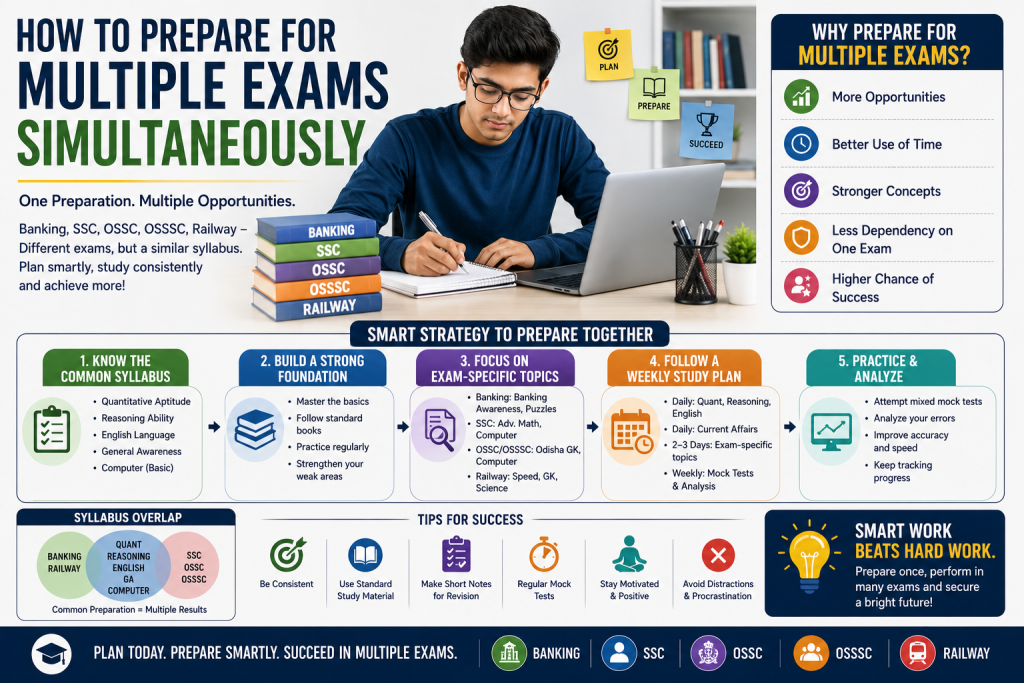
Relevant For: Banking • SSC • OSSC • OSSSC • Railway & Other Competitive Exams
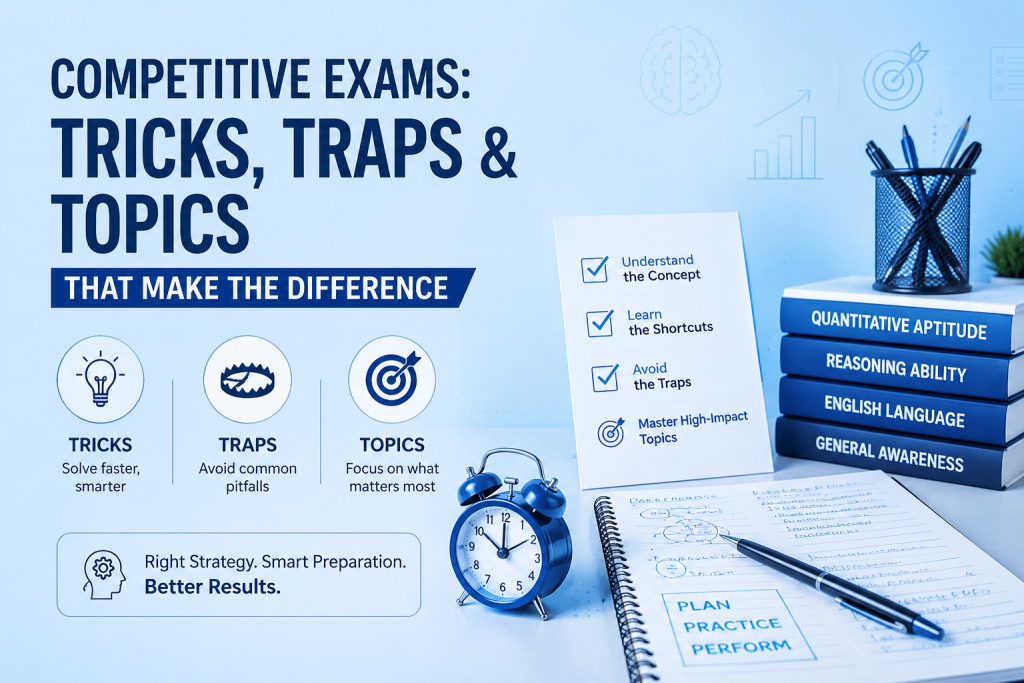
Quick Take: Competitive exams are not won by hard work alone. Strong fundamentals get you into the race, but speed techniques, awareness of examiner traps, mastery of high-impact topics and intelligent question selection often determine who finally clears the cut-off.
Hard Work Is Essential—but Is It Enough?
Most serious aspirants work hard. They attend classes, watch lectures, collect study materials, solve hundreds of questions and spend months preparing.
Yet their scores can remain surprisingly different.
Why?
Because competitive examinations do not simply test what you know. They test whether you can apply that knowledge accurately and quickly under pressure.
A student may know how to solve a quantitative aptitude problem but take four minutes to reach the answer. Another may recognise the pattern and solve it in forty seconds.
Both understand the concept. Only one has developed the technique required by the examination.
This distinction becomes increasingly important as competition rises.
1. Fundamentals Get You Started; Technique Takes You Further
There is no substitute for conceptual understanding.
Percentage, ratio, averages, grammar, syllogism or data interpretation cannot be mastered merely by memorising shortcuts. Fundamentals must come first.
But once the concept is understood, continuing to solve every problem through the longest conventional method is equally inefficient.
Competitive preparation should therefore progress through three stages:
Understand → Practise → Optimise
First understand why the method works. Then practise until it becomes comfortable. Finally learn whether the same problem can be solved faster.
That final stage is where tricks and shortcuts become valuable.
2. A Good Shortcut Saves Time Without Sacrificing Accuracy
The word trick is sometimes misunderstood.
A useful competitive-exam trick is not guesswork. It is a shorter logical route to the same correct answer.
Approximation, option elimination, ratio conversion, observation of number patterns and intelligent calculation can often reduce lengthy working.
But shortcuts have limits.
A memorised shortcut applied to the wrong situation can cost marks. Therefore:
Concept first. Shortcut second.
The objective is not to collect hundreds of tricks. It is to master a smaller number of reliable techniques and know when to use them.
3. Learn the Traps—Because Wrong Options Are Often Designed Deliberately
One of the least discussed aspects of competitive examinations is the quality of the wrong options.
Good multiple-choice questions do not always provide three ridiculous alternatives and one obvious answer. The incorrect options are often constructed around mistakes candidates commonly make.
Typical traps include:
- Ignoring an important condition in the question
- Solving for a related quantity instead of what was actually asked
- Applying the correct formula with the wrong interpretation
- Making assumptions not supported by the information
- Choosing an option that appears familiar
- Spending excessive time on a question simply because it looks solvable
Therefore, preparation should not stop with asking:
“Why is this answer correct?”
A stronger candidate also asks:
“Why are the other options wrong?”
That habit develops examination intelligence.
4. Some Topics Differentiate Scores More Than Others
Not every topic creates the same difference between candidates.
Some questions are straightforward. A well-prepared candidate is expected to answer them.
Other areas demand interpretation, judgement or several skills simultaneously. Performance differences become much wider there.
Examples may include:
Reading Comprehension (RC) – understanding the author’s argument, distinguishing fact from inference and eliminating options that are close but not supported.
Data Interpretation (DI) – combining arithmetic accuracy with calculation speed and intelligent selection.
Advanced Reasoning – identifying the correct structure before investing time in solving it.
Mains-level Quantitative Aptitude – deciding which method is efficient rather than merely knowing a method.
These are high-impact or differentiating topics. Improving them can sometimes add more to your final score than repeatedly practising areas you have already mastered.
5. Reading Comprehension Is a Classic Example
Consider Reading Comprehension.
Almost everyone can read the passage. Yet scores vary widely.
The difficulty often lies in the options.
An option may be:
directly stated, supported by the passage, reasonably inferred, partly true but exaggerated, or logically attractive but outside the passage.
The difference can be only a few words.
Simply reading more passages may improve general comprehension, but it does not automatically teach a candidate why a tempting option must be rejected.
That analytical ability is what separates reading from competitive-exam RC.
6. Know What You Can Prepare Effectively Yourself
Professional coaching should never replace self-study.
A large part of competitive preparation can—and should—be done independently.
Students can effectively handle routine activities such as concept revision, formula practice, vocabulary building, current affairs revision, basic question practice and repeated solving of familiar models.
Digital resources have made self-learning easier than ever.
The objective should therefore not be:
“Can I prepare without coaching?”
A better question is:
“Which parts can I master efficiently myself, and where would expert intervention save me significant time or repeated mistakes?”
That is a much more practical decision.
7. When Does Professional Guidance Become Valuable?
Professional assistance becomes useful when the problem is no longer simply a lack of information.
Consider seeking focused guidance when:
- You understand concepts but remain slow.
- Your mock-test score has stopped improving.
- You repeatedly make similar mistakes.
- You cannot understand why a particular option is incorrect.
- RC or advanced reasoning remains inconsistent despite practice.
- You know several methods but cannot decide which one to use.
- You attempt too many difficult questions and lose time.
- You struggle to convert knowledge into examination performance.
In these situations, another hundred random questions may not solve the problem.
You need someone to identify what is going wrong and why.
8. Mock Tests Should Diagnose, Not Merely Measure
A mock score tells you where you stand.
Mock analysis tells you why you stand there.
After every serious mock, candidates should examine three dimensions:
Knowledge Gap: Did I not know the concept?
Technique Gap: Did I know it but take too long?
Decision Gap: Should I have attempted this question at all?
This distinction is extremely important.
A candidate repeatedly treating a decision problem as a knowledge problem may keep studying more chapters without improving the score.
The purpose of mock analysis is therefore not simply to count correct and incorrect answers. It is to identify the cause of lost marks.
9. Learn Question Selection—the Hidden Skill
Competitive examinations reward marks, not heroism.
You do not receive additional marks for solving the toughest question on the screen.
An easier question solved in thirty seconds may carry the same marks as a difficult question consuming four minutes.
Strong candidates therefore develop the ability to decide quickly:
Solve now • Return later • Leave
This is a skill that should be practised deliberately during mocks.
Knowing when not to solve a question can be as valuable as knowing how to solve it.
10. Build a Smarter Preparation Model
A balanced competitive-exam strategy should combine four elements:
Concepts — understand the fundamentals.
Techniques — discover faster and more efficient approaches.
Trap Awareness — understand how questions and options can mislead you.
Performance Analysis — use mocks to identify where marks and time are being lost.
Self-study should remain the engine of preparation. Professional guidance should act as an accelerator where it genuinely adds value.
That combination is far more effective than either blindly depending on coaching or insisting on solving every preparation problem alone.
The Real Competitive Advantage
Competitive examinations are ultimately competitions in relative performance.
Knowing the syllabus is necessary. Practising questions is necessary. Working hard is necessary.
But when thousands of serious candidates possess similar study materials, the difference increasingly comes from how intelligently that knowledge is applied.
Learn the concepts. Discover the shortcuts. Recognise the traps. Strengthen the topics that differentiate scores. Analyse your mistakes—and seek expert guidance when repeated self-practice stops producing improvement.
That is where preparation begins turning into performance.
Prepare Smart. Get Guidance Where It Matters.
At Amrit Academy, we focus on the areas that often make the difference—strong concepts, smart techniques, exam traps, difficult topics and mock-test analysis—helping aspirants convert preparation into competitive performance.