
Target Exams: IBPS PO • IBPS Clerk • SBI PO • RBI Assistant • Regional Rural Banks
Quick Take: Cracking the IBPS examination is not about studying longer—it is about studying smarter. Build strong concepts, practise under time pressure, analyse every mock test, and prepare systematically for both Prelims and Mains from the very beginning.
Why Do So Many Aspirants Fail Despite Working Hard?
Every year, lakhs of graduates dream of securing a prestigious career in the banking sector through the IBPS PO and Clerk examinations. Yet, only a small percentage ultimately receive appointment letters.
The reason is not a lack of intelligence or effort. Most unsuccessful candidates study sincerely but follow an unstructured approach. They spend months collecting books, watching countless videos, and solving random questions without a clear plan.
Banking examinations are designed to assess speed, accuracy, logical thinking, decision-making, and consistency. Success depends not merely on how much you study, but on how effectively you prepare.
A structured strategy transforms preparation from hard work into smart work.
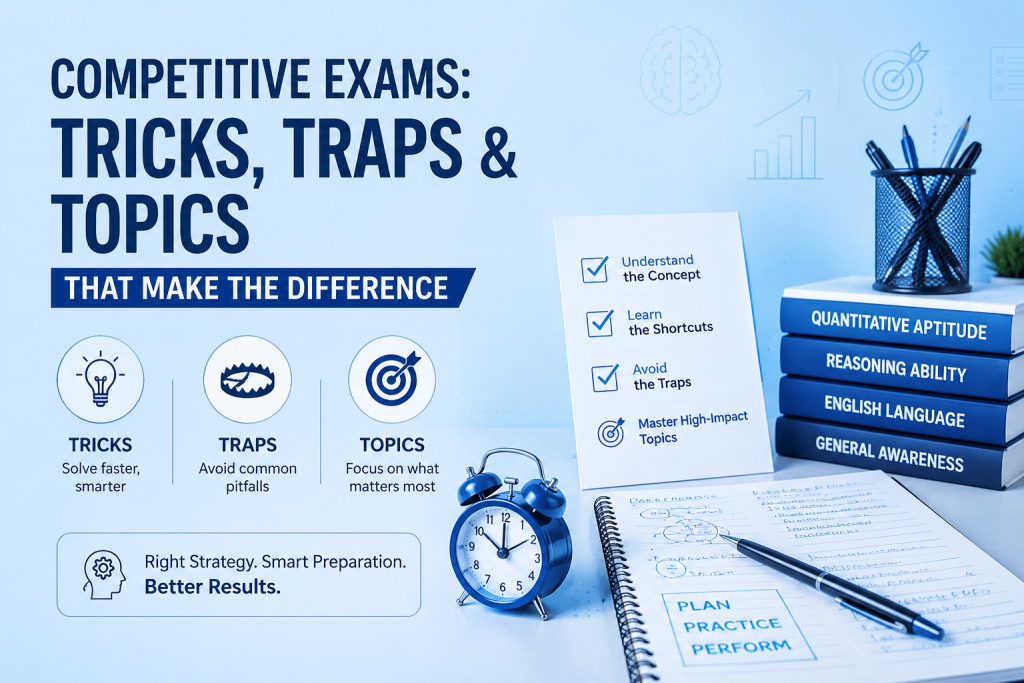
1. Understand the Examination Before Opening a Book
Every successful preparation begins with understanding the examination itself.
Before starting any subject, become familiar with:
- Examination stages (Prelims and Mains)
- Section-wise pattern
- Time allotted for each section
- Negative marking
- Expected difficulty level
- Previous years’ question trends
Many candidates begin studying immediately without understanding what the examination actually demands. As a result, valuable time is spent on topics with limited importance while high-scoring areas receive insufficient attention.
Knowing the examination is the first step towards mastering it.
2. Build Strong Fundamentals Before Looking for Shortcuts
One of the biggest mistakes made by beginners is searching for shortcuts on the first day.
Shortcuts work only when concepts are already clear.
Instead, spend the initial phase strengthening your fundamentals in:
- Quantitative Aptitude
- Logical Reasoning
- English Language
- Computer Awareness
- Banking & Financial Awareness
A candidate with clear concepts learns advanced techniques much faster than someone who memorises tricks without understanding the basics.
Remember, shortcuts improve speed—but concepts improve accuracy.
3. Study Every Day—Even If Only for a Few Hours
Consistency always beats intensity.
Studying for ten hours one day and skipping the next three days rarely produces good results. Instead, maintain a realistic daily schedule that can be followed for several months.
A balanced routine may include:
- Concept learning
- Practice questions
- Newspaper reading
- Current affairs revision
- Mock test analysis
Even three focused hours every day are more productive than irregular marathon study sessions.
4. Practise Under Examination Conditions
Many students solve questions without keeping track of time.
Unfortunately, the IBPS examination is as much a test of time management as it is of knowledge.
While practising:
- Set a timer.
- Attempt sectional tests.
- Avoid unnecessary breaks.
- Develop the habit of making quick decisions.
Timed practice trains your mind to remain calm under pressure and improves both speed and confidence.
5. Learn the Art of Question Selection
Not every question deserves your attention.
One characteristic common among high scorers is their ability to identify:
- Easy questions to solve immediately
- Moderate questions to revisit later
- Difficult questions to leave unanswered
Many candidates lose valuable marks by spending several minutes on one difficult question while easier questions remain untouched.
Smart question selection often contributes more to success than raw knowledge.
6. Accuracy Is More Important Than Attempts
Negative marking changes the entire strategy of the examination.
Attempting a large number of questions without confidence can reduce the overall score significantly.
A better approach is to:
- Read every question carefully.
- Solve confidently.
- Avoid blind guessing.
- Attempt only when reasonably certain.
As concepts improve, speed naturally follows. Accuracy should always come first.
7. Read Every Day to Improve English
English cannot be mastered through grammar rules alone.
Daily reading develops:
- Vocabulary
- Reading comprehension
- Sentence formation
- Grammar in context
- Editorial understanding
Reading quality newspapers, financial articles, magazines, or editorials for twenty to thirty minutes every day significantly improves performance in English while simultaneously strengthening General Awareness.
Reading is one habit that benefits multiple sections of the examination.
8. Prepare Current Affairs Systematically
Current Affairs is often neglected until the final month.
This is one of the biggest mistakes.
Instead of collecting hundreds of PDF files, prepare monthly and revise regularly.
Focus on:
- RBI and Banking Updates
- Government Schemes
- Indian Economy
- International Organisations
- Reports & Indices
- Awards & Honours
- Science & Technology
- Environment
- Defence
- Sports
- Important National & International Events
Regular revision is far more effective than last-minute memorisation.
9. Treat Mock Tests as Learning Tools
Many students judge themselves only by mock test scores.
The score is important—but the analysis is even more valuable.
After every mock test, analyse:
- Incorrect answers
- Unattempted questions
- Time spent per section
- Repeated mistakes
- Strong and weak topics
Every mock test should improve your strategy for the next one.
The objective is continuous improvement—not temporary satisfaction.
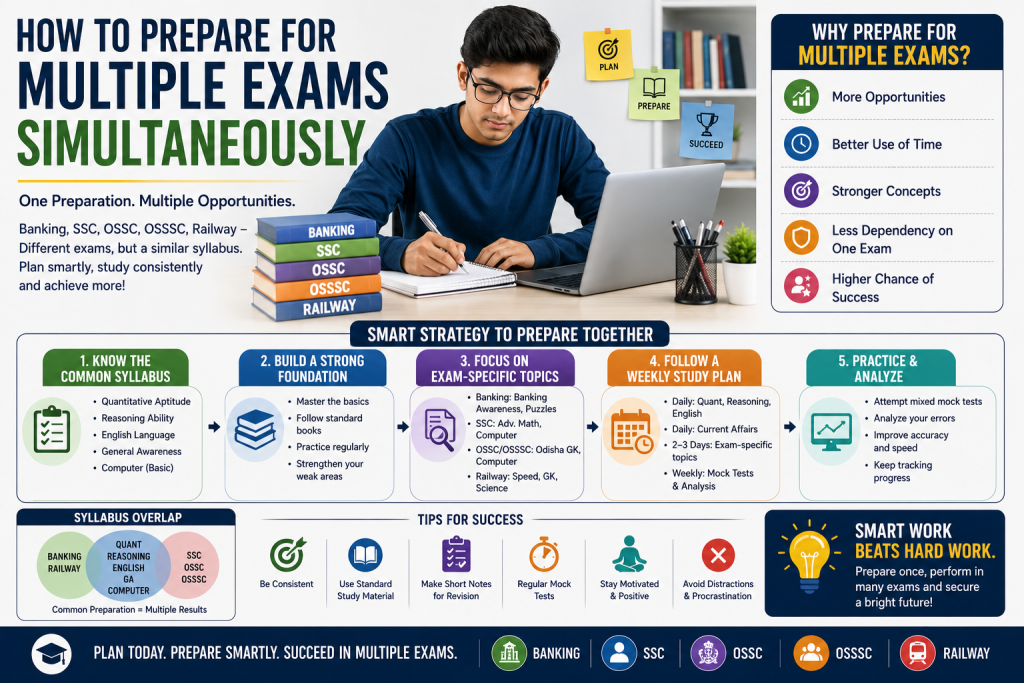
10. Prepare for Prelims and Mains Together
Waiting until after the Prelims to begin Mains preparation often creates unnecessary pressure.
Since a large portion of the syllabus overlaps, it is advisable to build concepts that are useful for both stages simultaneously.
Gradually introduce higher-level reasoning, advanced arithmetic, data interpretation, descriptive English, banking awareness, and current affairs into your routine.
Integrated preparation saves time and builds confidence.
11. Revise More Than You Read
Many aspirants continuously study new topics while forgetting what they learned earlier.
Knowledge without revision gradually disappears.
A practical revision strategy includes:
- Daily revision of the previous day’s work
- Weekly revision of important concepts
- Monthly revision through mock tests
- Short notes for formulas, vocabulary, and current affairs
Revision converts information into long-term memory.
Final Thoughts
Success in the IBPS examination is not determined by the number of books you own or the number of hours you study. It depends on having a structured preparation plan, mastering the fundamentals, practising consistently under examination conditions, analysing mistakes honestly, and continuously improving your performance.
The journey may be demanding, but it is entirely achievable for candidates who remain disciplined, patient, and focused on steady progress. Smart preparation, regular practice, and timely self-assessment are the real keys to securing a banking career.
Our Preparation Should Open More Than One Door.
At Amrit Academy, our integrated coaching approach prepares students for multiple competitive examinations through strong fundamentals, smart mentoring, and consistent practice—helping every hour of study create more career opportunities.