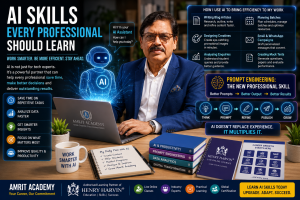
Artificial Intelligence is only as good as the instructions it receives.
Two professionals can ask the same AI tool the same question and receive completely different results—not because the AI is different, but because their prompts are different.
This is why Prompt Engineering has become one of the most valuable professional skills of the AI era.
You do not need to be a programmer to master it.
You simply need to learn how to communicate with AI clearly, logically and purposefully.
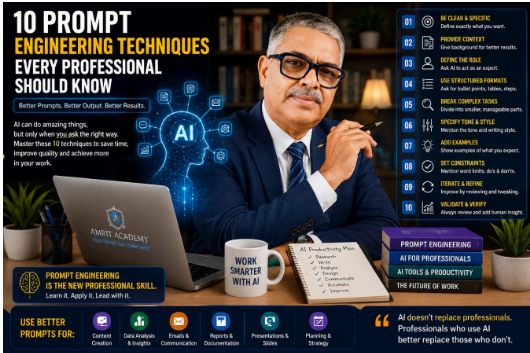
Here are ten practical prompt engineering techniques that every professional should learn.
1. Be Clear and Specific
AI cannot read your mind.
Instead of writing:
“Write about banking.”
Try:
“Write an 800-word blog for Banking aspirants explaining the differences between SBI PO and IBPS PO in simple English with headings, bullet points and a comparison table.”
The more precise your instruction, the better the result.
2. Give Context
AI performs much better when it understands the situation.
Instead of asking:
“Prepare an advertisement.”
Write:
“Prepare a Facebook advertisement for Amrit Academy promoting Accounts Pro to B.Com graduates in Odisha. Use a professional tone and include a call to action.”
Context improves relevance.
3. Assign AI a Role
One of the most powerful techniques is to tell AI who it should become.
Examples:
- “Act as a Chartered Accountant.”
- “Act as an experienced career counsellor.”
- “Act as a digital marketing expert.”
- “Act as an English language trainer.”
This helps AI respond from the appropriate professional perspective.
4. Define the Output Format
Never assume AI knows how you want the answer presented.
Specify whether you need:
- Bullet points
- Numbered lists
- Tables
- Blog articles
- Reports
- Emails
- PowerPoint outlines
- Excel formulas
A well-defined format saves editing time.
5. Break Complex Tasks into Steps
Instead of requesting everything in one prompt, divide large tasks into smaller stages.
For example:
Step 1 – Generate blog outline.
Step 2 – Expand each section.
Step 3 – Optimise for SEO.
Step 4 – Create social media captions.
Step 5 – Suggest an image concept.
Breaking work into stages produces higher-quality results.
6. Specify Tone and Audience
The same content should sound different for different readers.
Examples:
- Formal
- Friendly
- Professional
- Motivational
- Academic
- Conversational
Also identify your audience:
- Students
- Business Owners
- Teachers
- Working Professionals
- Senior Managers
AI writes more naturally when it knows who it is writing for.
7. Include Examples
Examples help AI understand exactly what you expect.
For instance:
“Write in the style of a career guidance article that uses short paragraphs, practical examples and simple English.”
Providing a reference style often produces more consistent output.
8. Set Constraints
Professional prompts include boundaries.
Examples:
- 800 words
- Maximum 10 headings
- Avoid technical jargon
- Use simple English
- Include one comparison table
- End with a practical conclusion
Constraints improve focus.
9. Review, Refine and Improve
The first response is rarely the final one.
Professionals improve AI output by asking follow-up questions such as:
- Simplify this section.
- Add practical examples.
- Rewrite for students.
- Improve the introduction.
- Make it more persuasive.
- Shorten the conclusion.
Prompt engineering is an iterative process.
10. Verify Before You Use
AI is a powerful assistant—not a substitute for professional judgement.
Always verify:
- Facts
- Statistics
- Dates
- Legal information
- Financial information
- Technical details
The final responsibility always belongs to the professional using the content.
A Practical Example
Imagine I want to create a blog for Amrit Academy.
A weak prompt would be:
“Write a blog on AI.”
A professional prompt would be:
“Act as an experienced career counsellor and SEO content writer. Write a 1,200-word blog titled ‘AI Skills Every Professional Should Learn’. The article should target students and working professionals, use simple English, include practical workplace examples, explain Prompt Engineering, provide clear headings, include a comparison table and conclude with a soft introduction to Henry Harvin’s AI learning programmes through Amrit Academy.”
Notice the difference.
The second prompt tells the AI:
- its role,
- the audience,
- the title,
- the tone,
- the length,
- the structure,
- and the purpose.
That is Prompt Engineering in action.
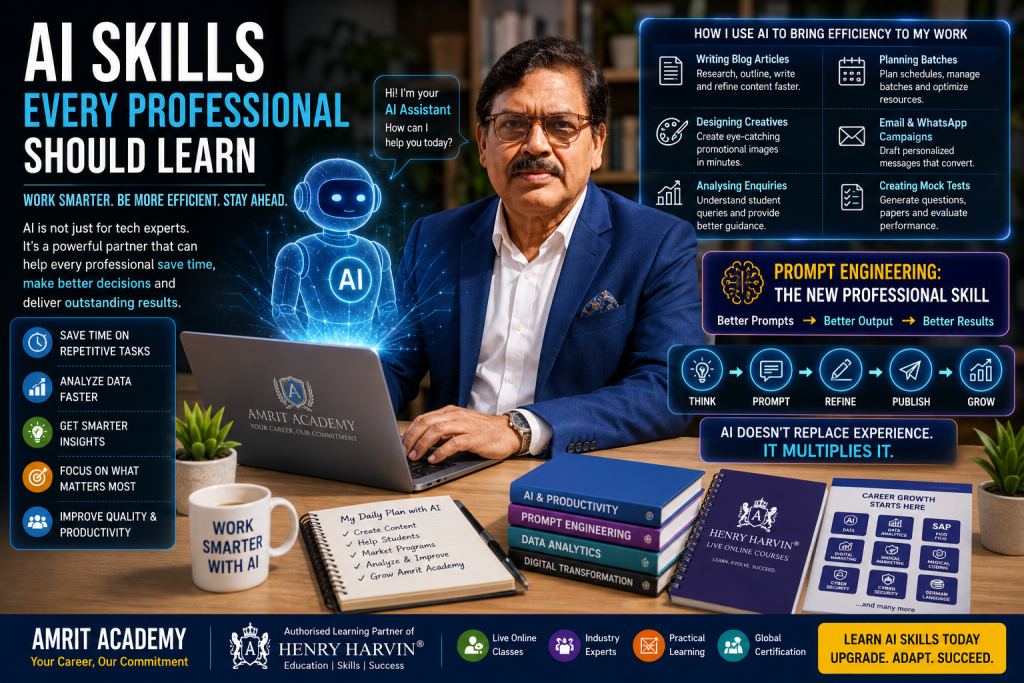
My AI Workflow at Amrit Academy
As an educator and entrepreneur, I use AI every day—not to replace my thinking, but to improve my productivity.
AI helps me:
- Develop competitive examination material.
- Write educational blogs.
- Design promotional campaigns.
- Prepare mock tests.
- Analyse student enquiries.
- Draft emails and WhatsApp messages.
- Create course roadmaps.
- Generate creative ideas.
The biggest lesson I have learned is this:
The quality of the answer depends on the quality of the prompt.
Better prompts lead to better thinking, better content and better decisions.
Prompt Engineering Is Becoming a Core Professional Skill
Whether you are:
- a student,
- an accountant,
- a teacher,
- a business owner,
- a manager,
- an HR professional,
- or an entrepreneur,
your ability to communicate effectively with AI will increasingly influence your productivity and career growth.
Prompt Engineering is not just an AI skill.
It is a thinking skill.
Professionals who learn it today will have a significant advantage tomorrow.
Learn AI the Practical Way
AI is evolving rapidly, but one principle remains constant:
Clear thinking produces clear prompts. Clear prompts produce better results.
Through practical AI learning programmes, professionals can master Prompt Engineering, AI productivity tools and real-world applications that improve efficiency across every industry.
As an Authorised Learning Partner of Henry Harvin, Amrit Academy helps students and working professionals build practical AI skills through live online learning, hands-on exercises and expert guidance.
Final Thoughts
The future of work will not belong only to people who know AI.
It will belong to people who know how to work with AI.
Prompt Engineering is rapidly becoming the bridge between human intelligence and artificial intelligence.
The sooner you learn to build that bridge, the more opportunities you will create for yourself.
Ask Better. Think Better. Prompt Better. Grow Faster.